

Welcome to plants@work
Welcome to the Plants at Work (formerly efig ltd) website - the association representing Interior Landscapers by promoting the use and benefits of Interior Plants.
There are many benefits of joining us, including:
- Industry Representation
- Great Business Opportunities
- Fantastic Training Programme
- Networking



News
-
From Niche to Necessity: New EU Report Validates the Power of Building-Integrated Nature Wednesday, 01 April 2026
-
The Women Who Shaped Landscaping and Interior Green Spaces Tuesday, 03 March 2026
-
Cultivating a Career in Interior Landscaping Tuesday, 03 March 2026
plants@work
The Man Who Taught the City to Love Interior Plants: Ian Drummond on 40 Years of Red Carpets and Living Architecture
From sculpting life-sized Cadillacs out of moss for Sir Elton John to pioneering the "Plantroom" revolution, interior landscaper Ian Drummond has spent four decades proving that plants are not just decor—they are essential infrastructure for the soul.
Tomorrow, plants@work is celebrating International Interior Landscaper Day. To mark the occasion, I sat down with industry stalwart Ian Drummond to chart his journey from a teenage apprentice to a leading voice in biophilic design and workplace diversity.

Joanna Hargreaves: You started your journey at just 16 (and were even working in floristry at 13). Looking back at that young apprentice in Victoria, what is the one piece of advice you’d give him about the industry he was about to spend four decades in?
Ian Drummond: I think back to those early mornings in Victoria—the smell of cut stems and damp earth. At 13, I was already hooked, spent my weekends nursing houseplants back to health. By 16, I was at Ken Hayfords, learning the technical grit of the trade. If I could tap that young man on the shoulder, I’d tell him: 'Trust your gut.' In horticulture, you can study the science, but you also have to 'feel' the plant. Early on, I was perhaps too quiet, but I’ve learned that my instincts about what a space needs are usually right. Confidence is a slow-growing thing, but it’s the most important tool in your kit.
JH: In 2001, plants were often an 'afterthought.' How has your design philosophy evolved as the industry shifted toward 'nature as infrastructure'?
ID: It’s been a total paradigm shift. We’ve moved away from the 'plant in a corner' era. My philosophy now is much more architectural. I’m no longer brought in at the end to 'soften' a room; I’m very often there at the table years in advance during the building design stages, consulting on the DNA of a place. We look at the brand’s identity, the airflow, and the lighting long before a pot is chosen. We aren't decorating anymore; we are building life-support systems for the people inside those buildings.
JH: When you celebrated 35 years, you spoke about the industry’s resilience. Now, at 40 years, what is the most significant change you’ve witnessed in how people perceive the "living" office or home?
ID: The wall between 'work' and 'home' has crumbled, and biophilic design is the glue holding it together. The statistics are startling: 21% of Londoners have no access to a private garden. In the heart of the city, that number leaps to 77%. For these people, an indoor garden isn't a hobby; it’s a vital connection to the natural world. People have finally realised that we aren't meant to live in sterile boxes—we need the rhythm of nature to stay sane.
JH: As the Diversity, Equality, and Inclusion Secretary for plants@work, what do you see as the industry’s greatest strength—and its biggest hurdle—when it comes to fostering a truly inclusive workforce?
ID: Our strength has always been our people—their passion and their diverse skills. But to keep the industry vibrant, we have to look like the society we serve. The hurdle is often visibility. We need to show young people from all backgrounds that horticulture isn't just 'gardening'; it’s design, it’s science, and it’s a legitimate, high-level career. Together we grow isn't just a slogan; it’s a biological fact. Monocultures fail in nature, and they fail in business, too.
JH: You recently launched the plants@work Pride Network. What was the catalyst for this?
ID: It came from seeing the success of out@indoor at Indoor Garden Design. The feedback was overwhelming—people just wanted to feel seen and supported within their professional community. Horticulture should be the most inclusive industry on earth; we literally celebrate growth and variety every day. Bringing that same energy to the LGBTQ+ community within our sector just felt like the natural next step.

JH: You’ve worked with iconic names like the Elton John AIDS Foundation and London Fashion Week. How do you reconcile a client’s very specific 'visual brand' with the practical, horticultural needs of the plants you’re using?
ID: I ask a lot of questions. So you are in a place where you completely understand the vision of the client. You have to be a bit of a detective. I need to inhabit that vision completely—whether that’s a high-fashion runway or a gala. You should also not be afraid to push boundaries and challenge the client as much as yourself! It’s about finding that perfect synergy where the aesthetic 'wow factor' meets horticultural integrity
JH: Which project from the last 40 years challenged you the most technically, and which one was the most rewarding emotionally?
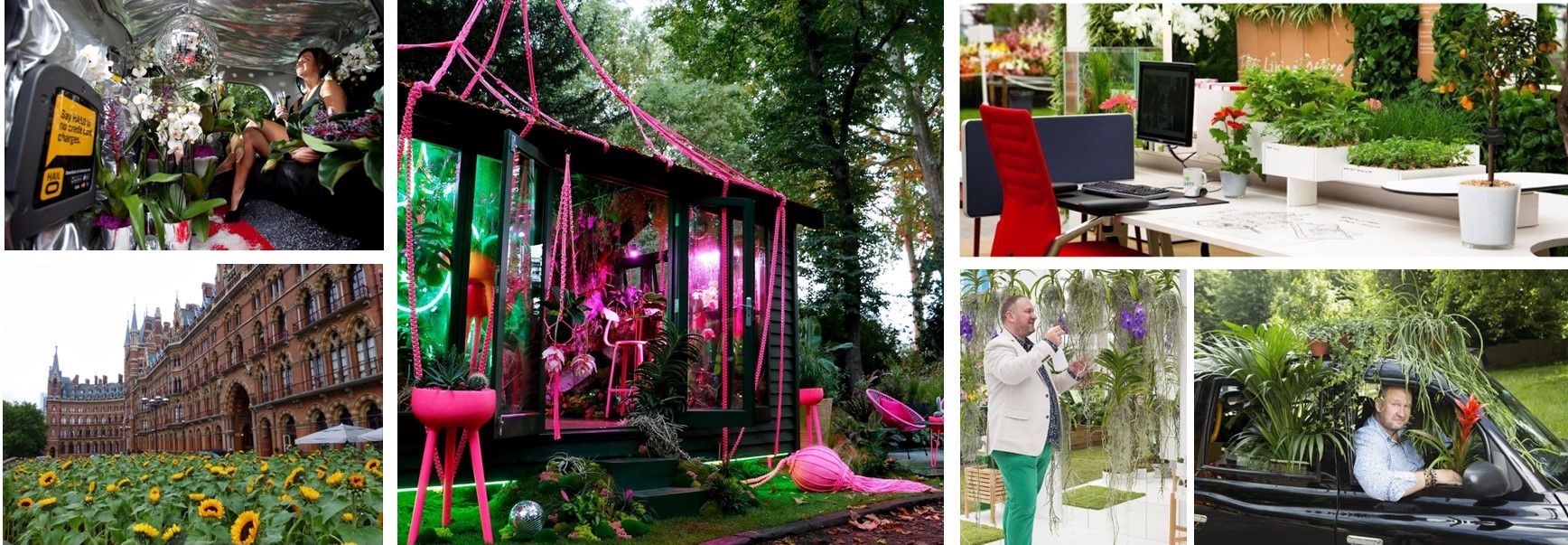
ID: Technically? Without a doubt, the life-sized 1954 Cadillac for Elton John’s White and Tiara Ball. We built a framework out of chicken wire and literally 'upholstered' it with living moss and plants. Watching guests approach it, convinced it was a real car that had miraculously sprouted leaves, was a career highlight.
Emotionally, it was Trinity Hospice in London. We designed a mobile planting scheme that could be moved into patients' rooms. Being invited back to hear from the patients about how those plants changed their outlook... that stays with you. It reminds you that what we do has real, healing power


JH: Beyond the red carpets and corporate atriums, you founded The Peggy Drummond Foundation in memory of your late mother. How has this philanthropic work in North London influenced your perspective on the social value of green spaces?
ID: The Foundation is incredibly personal to me. I set it up to honour my mother’s legacy, and it has become a way to give back to the streets where my journey began. In interior landscaping, we often talk about the luxury of biophilic design, but through the Foundation, I’ve seen that access to nature is a fundamental right.
We’ve focused on 'urban healing' in North London—things like under-planting street trees to turn dusty pavements into mini-ecosystems and donating benches to create spaces where neighbours can actually sit and connect. Being recognised with the Kentish Town Local Hero Award was deeply humbling, but the real reward is seeing a community reclaim its environment. It’s a reminder that whether you are designing for a global icon or a local street corner, the goal is the same: using plants to foster well-being and a sense of belonging. My mother loved the community, and I think she’d be proud to see these pockets of green bringing people together

JH: Your book At Home With Plants helped demystify houseplants for the public. What is the most common "plant myth" you still find yourself debunking even after four decades?
ID: The 'Helicopter Parent' syndrome! People think that if a plant looks sad, it needs a drink. In reality, most houseplants are killed by 'too much love'—otherwise known as overwatering. I’m constantly telling people: Put the watering can down. Check the soil first. Most plants would much rather be slightly dry than have 'wet feet
JH: How has your experience in large-scale commercial landscaping influenced the way you advise people on keeping plants in their private, everyday homes?
ID: In the commercial sector, we don't just 'place' plants; we use them to solve problems. When I walk into a home, I see the same opportunities. I advise people to stop thinking of plants as ornaments and start thinking of them as living architecture.
For instance, in open-plan offices, we use 'trough' planting to create soft walls. You can do the same at home. Instead of a wooden screen, use a tall, dense 'hedge' of Sansevieria or Kentia palms to separate your dining area from your lounge. It provides privacy and defines the 'zone' without blocking the light or the conversation.
We often use hanging plants in commercial atriums to lower the visual ceiling and make a space feel more intimate. By hanging trailing plants like Epipremnum or Aeschynanthus above your bed, you create a natural canopy. It’s a powerful biophilic 'hug' that signals to your brain it’s time to rest.
Your bathroom is the perfect place for plants. By installing a ceiling track of moisture-loving ferns or Tillandsia, you can create a living shower curtain. It’s functional, it thrives on the steam, and it turns a daily routine into a spa-like immersion in nature.
My background has taught me that when a plant has a functional purpose, it becomes a permanent part of the home’s DNA rather than just a temporary accessory.
JH: Beyond biophilic design, is there any "next big thing" you are seeing on the horizon for 2026 and beyond?
ID: We are moving toward 'Plantrooms.' Think of them as biophilic sanctuaries - the modern equivalent of a conservatory, spaces that are integrated into the heart of the home or office. These are plant filled rooms designed for wellbeing and helping with your mental health, designed for relaxation and meditation. We’re moving beyond the 'feature wall' to the 'feature environment.
JH: If you had to choose one plant that represents your 40-year career—perhaps something resilient, adaptable, and vibrant—which one would it be and why?
ID: Definitely the Vanda orchids. They are show-stoppers, they are resilient, and they don't even need soil to thrive—their roots just take what they need from the air. They’re adaptable, vibrant, and always make an entrance. After 40 years, I’d like to think I’ve learned to be just as adaptable

JH: And… Glamorous?
ID: I like to think so! But truly, the plants are the real stars of the show—I’m just lucky enough to be their agent and make sure they get the best dressing rooms. Here’s to the next forty years of keeping the world a little greener.
JH: Hear, hear and thank you for talking to me.

| About Ian:
With 40 years of expertise, Ian Drummond is a distinguished leader in interior landscaping. Formerly the Creative Director for Indoor Garden Design Ltd, he now operates his own consultancy, Ian Drummond Botanical Design. A multi-award winner at the RHS Chelsea Flower Show and the plants@work Leaf Awards, Ian is renowned for his high-profile installations for the Elton John AIDS Foundation, BAFTA, and London Fashion Week.
As a plants@work Ambassador and Equality and Diversity Secretary, he is a vocal advocate for inclusivity, recently launching the Pride Network. Ian is also the author of At Home With Plants and the founder of The Peggy Drummond Foundation, dedicated to bringing biophilic design and community support to the heart of North London.
|
- Tags: #BiophilicDesign, 40 Years, EJAF, Houseplants, Ian Drummond, Interior landscaping, LGBT+ Community