News
-
The Benefits of Indoor Plants in Classrooms: Celebrating Teachers’ Day with Nature’s Touch Monday, 05 October 2026
-
plants@work congratulates Ian Drummond on another accolade Wednesday, 30 September 2026
-
Celebrating Our Industry, Inspiring Its Future, Leaf Awards Conference, 8 October 2026 Tuesday, 22 September 2026
-
Don’t panic, stay calm – it’s 100 days to Christmas! Wednesday, 16 September 2026
plants@work
The Benefits of Indoor Plants in Classrooms: Celebrating Teachers’ Day with Nature’s Touch
5 October – Teachers’ Day
On Teachers’ Day, we celebrate the vital role educators play in shaping the minds and futures of the next generation. It is also an opportunity to consider the environments in which teachers and students spend so much of their time.

A classroom is more than a collection of desks, chairs, screens and whiteboards. It is a place where concentration, creativity, communication and wellbeing all need to come together.
Could bringing a little more nature into the classroom help?
An increasing body of research suggests that it can. Studies have explored the effects of indoor plants and other forms of nature on students’ attention, stress, perceptions of their learning environment and overall experience of being in the classroom.
The evidence is not a licence to claim that a few plants will automatically improve exam results or solve indoor-air-quality problems. But it does provide an increasingly interesting case for incorporating indoor plants and interior landscaping into a well-designed, healthy and nature-connected learning environment.
What does the research tell us?
Students respond positively to classrooms containing plants
Research involving real classroom environments has found that students prefer classrooms containing indoor plants and other forms of indoor nature. Some studies have also reported better attention and more positive evaluations of the learning environment.
Indoor plants may support attention and concentration
A study involving 23 school-age children found that viewing real foliage plants was associated with physiological responses linked to improved attention and concentration, as well as more positive feelings of comfort and naturalness.
Caring for plants may be particularly valuable
Research involving 35 junior-high students found that students who actively cared for classroom plants reported greater stress restoration than those who did not. Both active and passive interaction with plants were associated with greater self-reported attention restoration.

But the evidence needs to be interpreted carefully
A systematic review of research into nature in educational environments concluded that the evidence is promising but still developing, with differences in study methods and limitations in the quality of evidence. The authors called for more robust, real-world and long-term research.
Plants are not a substitute for ventilation
Research into classroom CO₂ levels demonstrates the importance of good ventilation and monitoring indoor air quality. More recent research has also found that adding plants can improve students’ perceptions of their classroom environment without necessarily changing objectively measured air-quality parameters.
The message is therefore not “plants instead of ventilation”. It is “plants alongside good indoor-environment management.”
A healthy classroom starts with a healthy indoor environment
Before considering the benefits of plants, it is important to recognise the fundamentals of a healthy classroom.
Ventilation, temperature, humidity, lighting, acoustics and indoor air quality all influence the experience of students and teachers.
A 2021 study by Di Gilio and colleagues monitored CO₂ concentrations in 11 classrooms across nine schools in southern Italy. During the initial monitoring period, all classrooms experienced periods in which CO₂ concentrations exceeded 700 ppm, and six of the 11 classrooms had mean concentrations above 1,000 ppm. The researchers subsequently introduced real-time CO₂ monitoring and ventilation guidance, producing substantially better results.
The study demonstrates an important principle: the indoor environment needs to be actively managed.
Plants should therefore never be presented as a replacement for fresh-air ventilation or mechanical ventilation where it is required.
Instead, indoor plants can be considered alongside these measures as one element of a classroom designed around the needs of its occupants.
Research shows that students like classrooms with plants
One of the most directly relevant pieces of research is the 2020 study “Greening the classroom”, which examined indoor nature in real-life educational settings.
The researchers conducted three field experiments involving classrooms at a university, secondary school. Students consistently preferred classrooms containing indoor nature compared with classrooms without it.
Among secondary-school students, indoor nature was also associated with improved self-reported attention, as well as better evaluations of the teacher and lecture.
These findings are particularly interesting because the research was carried out in real educational environments, rather than relying solely on photographs or laboratory simulations.
It suggests that plants can influence not just how a classroom looks, but how students experience the space.

Real plants and attention
Could simply looking at a plant make a difference?
A 2019 study involving 23 students aged 11–13 explored children's physiological and psychological responses when viewing a real plant, an artificial plant, a photograph of a plant, or no plant.
The researchers used electroencephalography (EEG) alongside assessments of the students’ mood. Viewing real foliage plants was associated with changes in frontal-lobe theta activity, which the researchers interpreted as indicating improved attention and concentration. Students also reported greater feelings of comfort and naturalness when viewing living plants.
The researchers were careful to identify the limitations of their work, including the small sample size and the fact that the experiment measured relatively short-term responses.
Nevertheless, it adds to the growing evidence that living indoor plants can have a different psychological and physiological effect from an artificial representation of nature.
Don't just look at plants – care for them
Perhaps one of the most interesting findings for schools is that the benefits of plants may extend beyond simply having them in the room.
A field experiment conducted at a junior high school in Taiwan followed 35 students over a semester. One group actively cared for plants in and around the classroom, while another group had passive exposure to the plants without responsibility for their care.
The students who actively interacted with and cared for the plants reported significantly greater stress restoration. Both active and passive interaction with plants were associated with increased self-reported attention restoration.
This suggests an important practical opportunity for schools.
Rather than treating plants simply as decoration, teachers can make them part of classroom life.
Students could take responsibility for watering and checking plants, recording growth, observing new leaves or flowers, researching their origins and understanding the conditions they need to thrive.
A houseplant can become a living teaching resource.
Plants can support hands-on learning
Indoor planting provides opportunities to connect classroom learning with the natural world. This can be particularly valuable at a time when many children spend increasing amounts of their lives surrounded by technology and artificial environments.
A classroom plant offers something very different: something living that changes gradually and requires care.

A more restorative learning environment
The potential benefits of indoor plants extend beyond individual specimens.
A systematic review published in Health & Place examined 37 studies looking at nature in secondary and tertiary educational environments. The researchers found promising indications of benefits associated with nature, including perceived restoration and quality of life, but concluded that the evidence base was still limited and that no firm conclusions could yet be drawn about overall effects on wellbeing or academic outcomes.
That caution is important.
It would be misleading to claim that indoor plants have been proven to improve every aspect of students’ wellbeing or academic performance. The research is still developing.
But the findings do provide enough evidence to support further exploration of interior landscaping and biophilic approaches to educational design.
What about academic performance?
This is an area where the distinction between association and causation is particularly important.
Research has found encouraging relationships between the amount of vegetation around schools and academic achievement.
For example, a study of 450 public schools in Washington State examined the relationship between school planting and sixth-grade reading and mathematics results. Several statistical models found positive associations between the amount of vegetation around schools and achievement, with tree canopy within approximately 250 metres of schools showing particularly strong relationships.
This does not demonstrate that putting plants inside a classroom will improve exam results.
It does, however, add to a wider body of research suggesting that access to natural elements in and around educational environments may be beneficial for students.
The distinction matters – and it is why plants@work advocates for evidence-based biophilic design rather than making claims that go beyond the research.

A recent study adds another important perspective
Research published in Building and Environment in 2025 looked specifically at biophilic design in university classrooms.
The researchers introduced 50 plants into a classroom and later increased the number to more than 100. Students reported improvements in their perceptions of air quality, environmental quality and productivity when plants were present.
However, the researchers found that the plants did not produce significant changes in objectively measured indoor-air-quality parameters. Increasing the number of plants from 50 to more than 100 also did not produce further improvements in students’ perceptions.
This is a valuable finding because it reinforces the distinction between perceived environmental quality and measurable air quality.
Students may feel that a classroom with indoor plants is fresher, more pleasant and more conducive to productivity, while proper ventilation remains essential for managing the actual indoor environment.
Again, the message is simple:
Plants complement good environmental design; they do not replace it.
Creating a classroom where people want to be
There is also something less tangible, but arguably just as important, about the presence of plants.
Indoor planting can soften the visual impact of desks, screens and hard surfaces. It can introduce colour, texture and natural forms into an otherwise highly structured environment.
A classroom with plants can feel more welcoming and less institutional.
And this matters for teachers as well as students.
Teachers spend many hours each week in their classrooms. Creating spaces that feel comfortable, engaging and connected to nature can contribute to a more positive working environment.
From classroom decoration to interior landscaping
The evidence increasingly points towards thinking about plants as part of something bigger than decoration.
Biophilic design considers how buildings and interiors can incorporate people's innate connection with nature through natural materials, plants, daylight, views, patterns, textures and opportunities for interaction with the natural world.
Indoor plants are one of the most accessible elements of this approach.
They can be introduced at different scales – from a few carefully selected houseplants on shelves or windowsills to larger planting schemes, green walls or dedicated indoor growing areas.
Professional interior landscaping can also provide a considered approach to plant selection, positioning, maintenance and long-term care, ensuring that plants are appropriate for the available light, temperature, space and level of use.
The right solution will depend on the building, the students, the curriculum, maintenance requirements and the available budget.
So, should classrooms have plants?
The research does not support the simplistic claim that “plants make students get better grades” or that they “clean classroom air instead of ventilation.”
It does support something more nuanced – and arguably more useful.
Research in real educational environments has found that students often prefer classrooms containing indoor plants and other forms of indoor nature, with some studies reporting improvements in attention and classroom evaluations. Other research has found benefits associated with active interaction with plants, including greater reported stress restoration. Studies involving school-age children have also found promising physiological and psychological responses to living plants.
At the same time, systematic review evidence tells us that the overall research base is still developing and that more rigorous, long-term studies are needed.
That is not a reason to dismiss the potential of indoor plants.
It is a reason to use them thoughtfully, measure their impact and continue building the evidence base.
This Teachers’ Day, as we recognise the dedication of teachers and the vital role they play in helping young people learn and grow, perhaps we should also think about the spaces in which that learning takes place.
Good ventilation and indoor environmental management are essential.
But alongside these fundamentals, bringing indoor plants into classrooms can provide opportunities to support attention, create a more welcoming environment, encourage interaction and give students a direct relationship with the living world.
And perhaps the most appropriate lesson of all is one that plants demonstrate every day:
Growth needs the right environment.
This Teachers’ Day, let's give teachers and students classrooms designed to help them thrive – with good air, good light, good design and, wherever possible, a few well-chosen indoor plants.
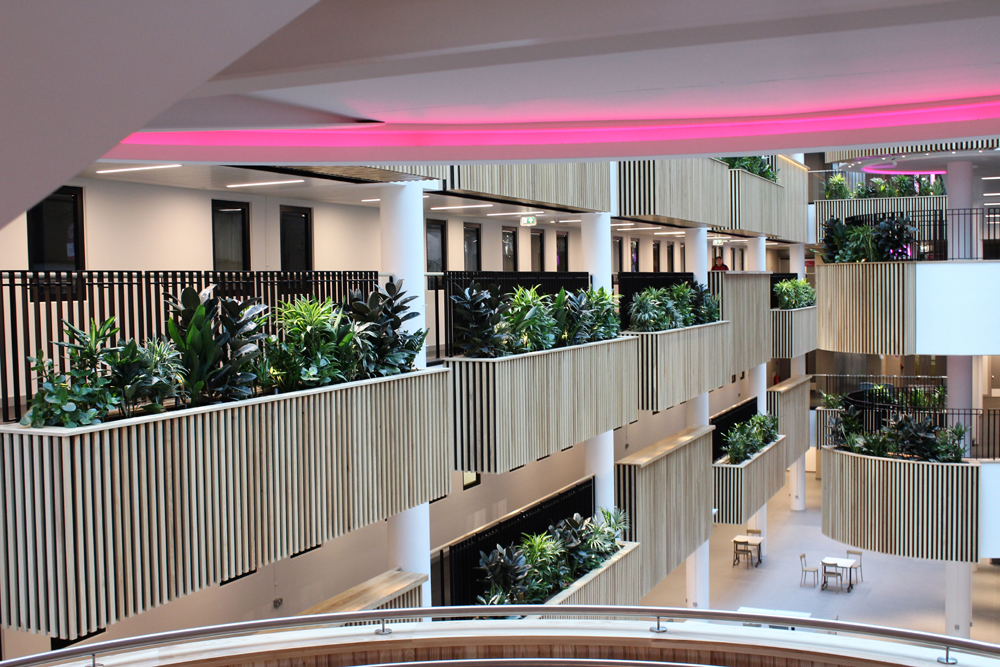
Part of the planted atrium at Sheffield Hallam, designed and planted by Urban Planters South Yorkshire
Research and references
Di Gilio, A., Palmisani, J., Pulimeno, M., Cerino, F., Cacace, M., Miani, A. & de Gennaro, G. (2021). CO₂ concentration monitoring inside educational buildings as a strategic tool to reduce the risk of SARS-CoV-2 airborne transmission. Environmental Research, 202, 111560. DOI: 10.1016/j.envres.2021.111560.
van den Bogerd, N., Dijkstra, S.C., Tanja-Dijkstra, K., de Boer, M.R., Seidell, J.C., Koole, S.L. & Maas, J. (2020). Greening the classroom: Three field experiments on the effects of indoor nature on students' attention, well-being, and perceived environmental quality. Building and Environment, 171, 106675. DOI: 10.1016/j.buildenv.2020.106675.
Han, K-T. (2018). Influence of passive versus active interaction with indoor plants on the restoration, behaviour and knowledge of students at a junior high school in Taiwan. Indoor and Built Environment, 27(6), 774–783. DOI: 10.1177/1420326X17691328.
Oh, Y-A., Kim, S-O. & Park, S-A. (2019). Real foliage plants as visual stimuli to improve concentration and attention in elementary students. International Journal of Environmental Research and Public Health, 16(5), 796. DOI: 10.3390/ijerph16050796.
van den Bogerd, N., Dijkstra, S.C., Koole, S.L., Seidell, J.C., de Vries, R. & Maas, J. (2020). Nature in the indoor and outdoor study environment and secondary and tertiary education students’ well-being, academic outcomes, and possible mediating pathways: A systematic review with recommendations for science and practice. Health & Place, 66, 102403. DOI: 10.1016/j.healthplace.2020.102403.
Li, K., Perrault, A., DeYoung, W.A., Cameron, E., Miller, C.T. & O’Connor, A.S. (2025). Impact of biophilic design on college student perception of mental health and environmental benefits: A dose-response study. Building and Environment, 267, 112318. DOI: 10.1016/j.buildenv.2024.112318.
Greening for academic achievement: Prioritizing what to plant and where (2021). Landscape and Urban Planning, 206, 103962. DOI: 10.1016/j.landurbplan.2020.103962.